
08/08/2020
The Global Positioning System (GPS) has revolutionized navigation, impacting everything from personal travel to global logistics. At the heart of GPS technology lies the exchange of data through NMEA sentences, a standardized communication protocol. This article delves into the world of GPS NMEA sentences, exploring their structure, common sentence types, and practical applications.

Understanding NMEA Sentences
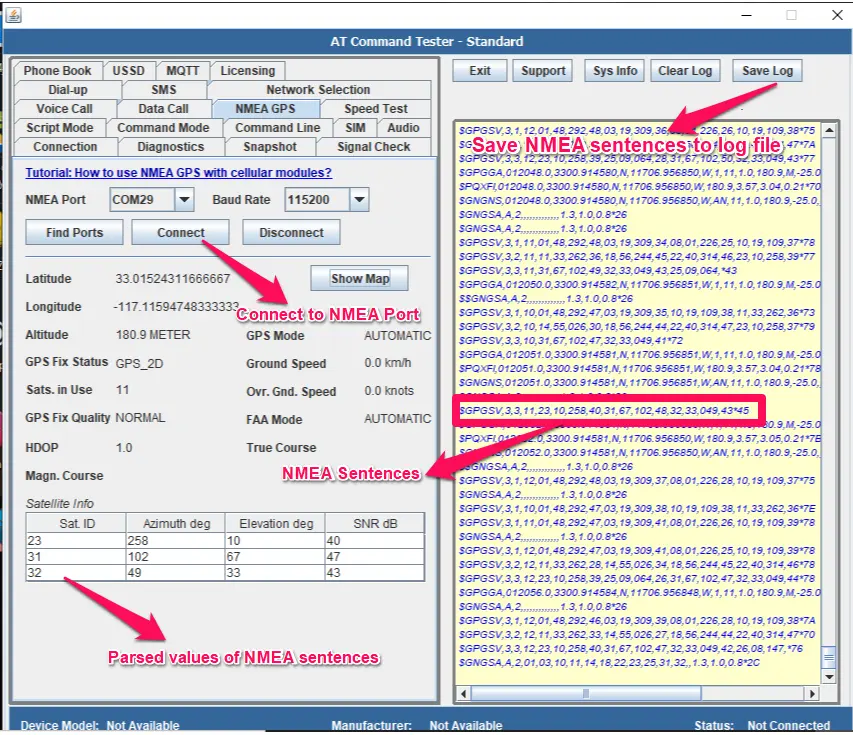
NMEA 0183 is a widely used standard for exchanging navigational data between GPS receivers and other devices. Data is transmitted as ASCII text strings, known as NMEA sentences, each beginning with a dollar sign ($) and ending with an asterisk () followed by a checksum. This checksum ensures data integrity.
A typical NMEA sentence follows this structure: $GPXXX,Data1,Data2,…,Checksumwhere:
$: Indicates the start of the sentence.GPXXX: The talker ID (e.g., GP for GPS, GN for GLONASS). XXX represents the sentence type (e.g., RMC, GGA, GSA).Data1,Data2,…: Comma-separated data fields specific to the sentence type.Checksum: A hexadecimal value verifying data integrity.
Common NMEA Sentences
Numerous sentence types exist, each providing different navigational information. Some of the most frequently used include:
| Sentence Type | Description | Key Data Fields |
|---|---|---|
| GGA (Global Positioning System Fix Data) | Provides current GPS fix information, including latitude, longitude, altitude, and time. | Time, Latitude, Longitude, Quality Indicator, Number of Satellites, HDOP, Altitude, Geoid Separation |
| RMC (Recommended Minimum Navigation Information) | Contains essential navigation data, including position, course, and speed. Often considered the most important sentence for basic navigation. | Time, Status, Latitude, Longitude, Speed, Course, Date, Magnetic Variation |
| GSA (GPS DOP and Active Satellites) | Indicates the GPS satellites used for the current position fix, along with dilution of precision (DOP) values. | Mode, Fix Type, Satellite IDs, PDOP, HDOP, VDOP |
| GST (GPS Pseudorange Noise Statistics) | Provides information about the precision of the GPS position fix. | Time, RMS Value of Pseudorange Errors, Latitude Error, Longitude Error, Altitude Error, Major Axis of Error Ellipse, Minor Axis of Error Ellipse, Orientation of Error Ellipse |
| VTG (Course Over Ground and Ground Speed) | Displays the course and speed over ground in various units. | Course (True North), Course (Magnetic North), Speed (Knots), Speed (km/h) |
Interpreting NMEA Data
Understanding the data fields within each sentence is crucial for utilizing the information effectively. For instance, the RMC sentence provides essential navigation parameters. The time, latitude, and longitude pinpoint the location, while speed and course indicate movement. The status field indicates the validity of the position data (A for valid, V for invalid).
The GGA sentence offers additional context, including altitude and the number of satellites used for the fix. The quality indicator reflects the reliability of the position. A higher number of satellites and a lower HDOP (Horizontal Dilution of Precision) suggest a more precise location.
Practical Applications of NMEA Sentences
NMEA sentences are fundamental to numerous applications, including:
- Marine Navigation : GPS chart plotters, autopilots, and other onboard systems rely on NMEA data for accurate positioning and navigation.
- Automotive Navigation : Modern vehicles utilize NMEA data to provide real-time location, route guidance, and traffic information.
- Aviation Navigation : Aircraft navigation systems use NMEA data integrated with other sensor information for precise flight control and monitoring.
- Fleet Management : Businesses track their vehicles and assets using GPS devices and NMEA data to optimize routes and improve efficiency. This helps reduce fuel costs and enhances overall fleet management.
- Tracking Devices : Personal trackers, wildlife tracking collars, and asset trackers rely on NMEA data to provide location information in real-time or for later analysis. This finds applications in various contexts including logistics, wildlife conservation, and personal safety.
Advanced Topics
Beyond the basic sentences, more specialized NMEA messages cater to specific needs. Some of these advanced topics include:
- GLONASS and Galileo Integration : NMEA supports data from other global navigation satellite systems (GNSS) like GLONASS and Galileo, expanding coverage and improving accuracy.
- Data Filtering and Smoothing : Techniques exist to filter out noisy data and smooth GPS signals, resulting in more stable and accurate position information. This is particularly useful in challenging environments.
- Error Correction and Compensation : Advanced algorithms can correct for errors caused by atmospheric conditions or multipath effects, further improving accuracy.
- Integration with Other Sensors : NMEA data can be combined with data from other sensors, such as accelerometers and gyroscopes, for even more precise tracking and navigation. This fusion of data from multiple sources improves the robustness and reliability of the overall navigation system.
Troubleshooting Common Issues
Working with NMEA sentences can occasionally present challenges. Here are some common issues and solutions:

- Checksum Errors : Incorrect checksums indicate corrupted data. Verify the sentence structure and recalculate the checksum.
- No GPS Signal : Ensure the GPS receiver has a clear view of the sky and is properly powered. Obstructions or interference can disrupt the signal.
- Data Interpretation Problems : Refer to the NMEA standard documentation for precise data field definitions and interpretations. Utilize readily available tools and libraries to ease data processing.
GPS NMEA sentences are the backbone of many location-based services. Understanding their structure, common sentence types, and practical applications is essential for developers and users alike. The continued evolution of GPS technology and the integration of new GNSS constellations promise to further expand the capabilities and accuracy of this indispensable technology.